FlemingClans.com

"Scotland's Fleming Clan: a Genealogical History" - coming in 2027!
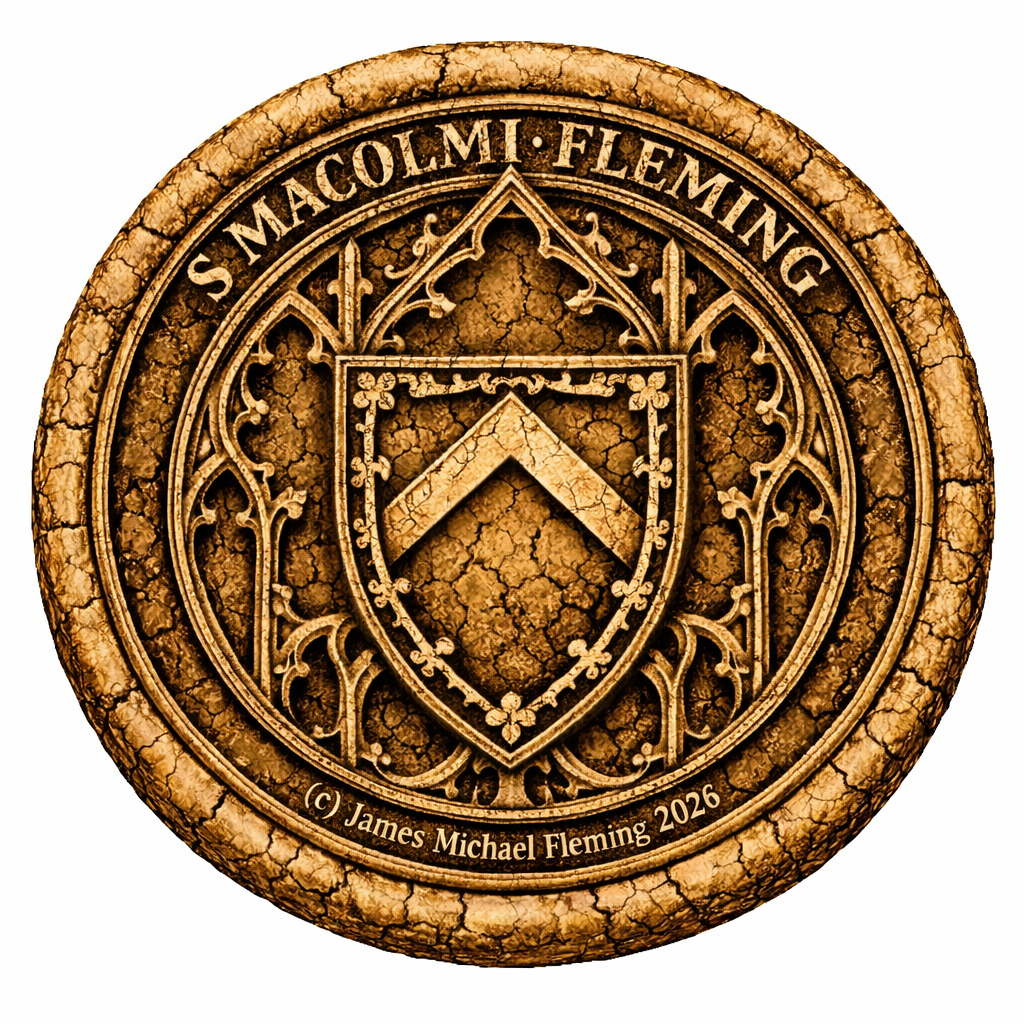 9th chief - Sir Malcolm Fleming, 8th of Biggar
(c1312 - c1396)
Basic information about this person: \click here\
Malcolm Fleming of Biggar, son of Patrick Fleming and Joan Fraser, served King David II and the first two Stewart kings for half a century. In 1382 he inherited the leadership of the Fleming clan from his cousin Thomas, uniting the Biggar estates with Lenzie and Cumbernauld.
Neville’s Cross
Malcolm was born around 1312, probably at Biggar. He was still a young man when he followed his kinsman Malcolm Fleming, 1st Earl of Wigtown, to war. At the Battle of Neville’s Cross near Durham on 17 October 1346 the Scots were defeated and King David II was captured. Both Malcolms were taken prisoner and committed to the custody of Robert Bertram, Sheriff of Northumberland.
Reward from King David II
After his return Malcolm became a trusted servant of the king. In April 1357 the Earl of Wigtown granted him the lands of Achmoir, Seymoir and others, and on 11 January 1358 King David granted him all the lands in the barony of Lenzie that had been forfeited by the late John Kennedy. This grant was confirmed by royal charter in 1362. The royal accounts record a steady stream of payments and gifts to him, including a cask of wine in 1359.
Keeper of Dunbarton Castle
By 1364 Malcolm was Sheriff of Dunbarton and Governor of Dunbarton Castle, the same posts his kinsman the Earl had held when he sheltered the young King David there in 1333. In July 1364 the king instructed him to collect only five chalders of oatmeal from Paisley Abbey for the castle’s upkeep, and had to remind him of this in December. Malcolm remained governor until at least 1368, when he took part in an inspection of the royal castles to identify repairs. He also attended the General Council at Perth in January 1365.
Building the estates
Malcolm was an active manager of land. In 1372 he was raised from tenant to hold Kidston in Berwickshire directly from the crown, and later that year sold it to William, Earl of Douglas, for six hundred pounds. The seal he used on that occasion bears a chevron within a double tressure flowered and counter-flowered, the arms of the Fleming chiefs.
Also in 1372 he bought lands in Lenzie from William Boyd, and in 1375 he took over from Boyd the eighty pound mortgage that his cousin Thomas had raised on Lenzie. By 1388 he held Thankerton, Biggar, Crawfordjohn, Colbanston, Dalziel, Kilbride, Strathaven, Stanhouse and other lands. In 1384 he granted the feu of Kirkintilloch to Gilbert Kennedy, to be held of himself and his heirs.
Head of the family
In September 1382 his cousin Thomas Fleming, 2nd Earl of Wigtown, resigned the baronies of Lenzie and Cumbernauld in Malcolm’s favour, and the king ratified the transfer on 20 September. Malcolm was now chief of the Fleming clan.
His standing at court rose under the Stewart kings. In 1379 he was steward to the Earl of Carrick, the future King Robert III. By 1381 he was Sheriff of Edinburgh and Governor of Edinburgh Castle, and he still held the sheriffdom in 1388. He witnessed royal charters at Scone in 1374 and 1394 and at Holyrood in 1390.
Marriage and legacy
Malcolm married Christian de Carric. Their sons were David, his heir, and Patrick, who became the first Fleming of Bord. In July 1395 Malcolm granted Badynache to his grandson William Boyd. Shortly before his death, with the consent of his son David, he pledged his lands of Blance near Haddington to Alexander Cockburn of Langton for twenty pounds. He died between 1395 and 1398.
Malcolm’s long and dependable service earned him the nickname “the Reliable”. He passed to his son a much enlarged inheritance and a family firmly established among the leading houses of Scotland.